MERV Ratings Explained
What the numbers on your filter mean. MERV ratings run from 1 to 16 and show how well an HVAC filter catches small particles. What each range traps and why EPA suggests MERV 13 when possible.
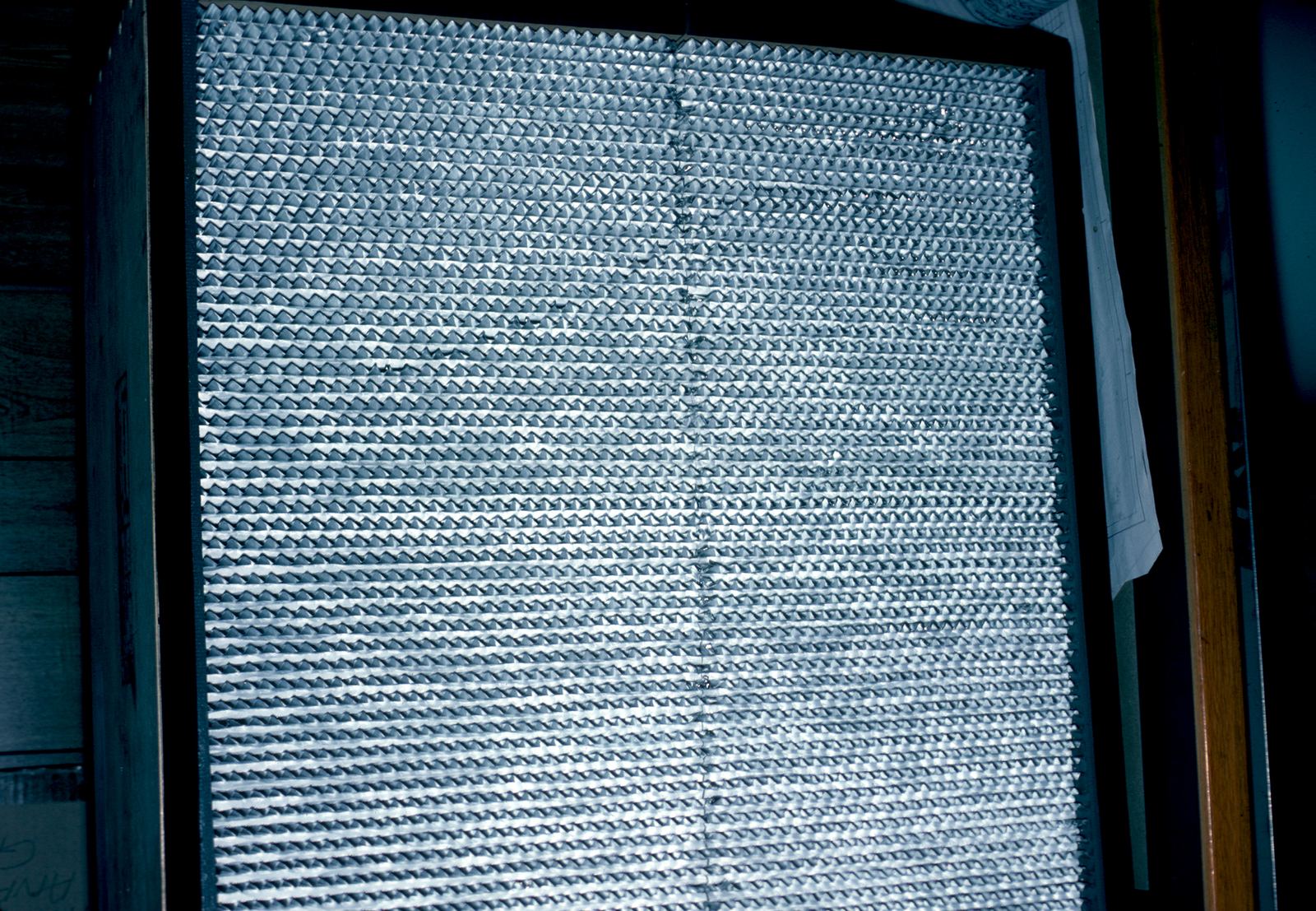
Pleated filter media up close: Livestock Industries, CSIRO, CC BY 3.0
Where MERV comes from
MERV stands for Minimum Efficiency Reporting Value. It comes from ASHRAE Standard 52.2, a laboratory test that measures how well a filter captures particles between 0.3 and 10 microns, grouped into three size ranges. A human hair is roughly 50 to 70 microns wide, so these are tiny particles.
The result is a single number from 1 to 16. Higher numbers mean the filter catches a bigger share of small particles.
What each range catches
Low MERV filters, roughly 1 to 4, are the thin fiberglass kind. They mainly protect the equipment from lint and large dust. MERV 5 to 8 pleated filters catch more dust, pollen and mold spores.
MERV 9 to 12 filters do better on finer particles, and MERV 13 to 16 filters capture a large share of particles in the smallest test range, 0.3 to 1 micron, the size of much smoke and many fine particles.
What the EPA says
The US Environmental Protection Agency suggests using a filter rated MERV 13 or higher where your HVAC system can accommodate it, or as high as your system allows. A filter only cleans air that passes through it, so the fan has to run and the filter has to fit its slot without gaps.
Check your equipment manual or ask a technician before jumping several MERV steps, because denser filters can add resistance to airflow in some systems.
MERV is not the whole story
Filter thickness matters. A deeper four or five inch pleated filter has more surface area than a one inch filter of the same rating, which usually means lower resistance and a longer life.
Different brands sometimes use their own scales, such as FPR or MPR. MERV is the industry standard number, so it is the easiest way to compare filters from different makers.
Matching a filter to your home
A practical way to choose is to start with what the system was designed for. Many standard residential systems handle a pleated MERV 8 to 11 filter without trouble, and many can take MERV 13, especially in a thicker media cabinet. If you upgrade, watch for signs of low airflow, such as weaker air at the registers or a filter that bows inward.
Smoke from wildfires, construction dust and pets are common reasons people move to a higher rated filter. Higher MERV filters may need changing more often as they load with fine particles.
- US EPA: What is a MERV rating?
- ASHRAE: Standards and Guidelines
- Wikipedia: Minimum efficiency reporting value
Facts on this page were checked against these sources.
- Pleated filter media up close: Livestock Industries, CSIRO, CC BY 3.0
Text written by Clear Air Cleaning.